

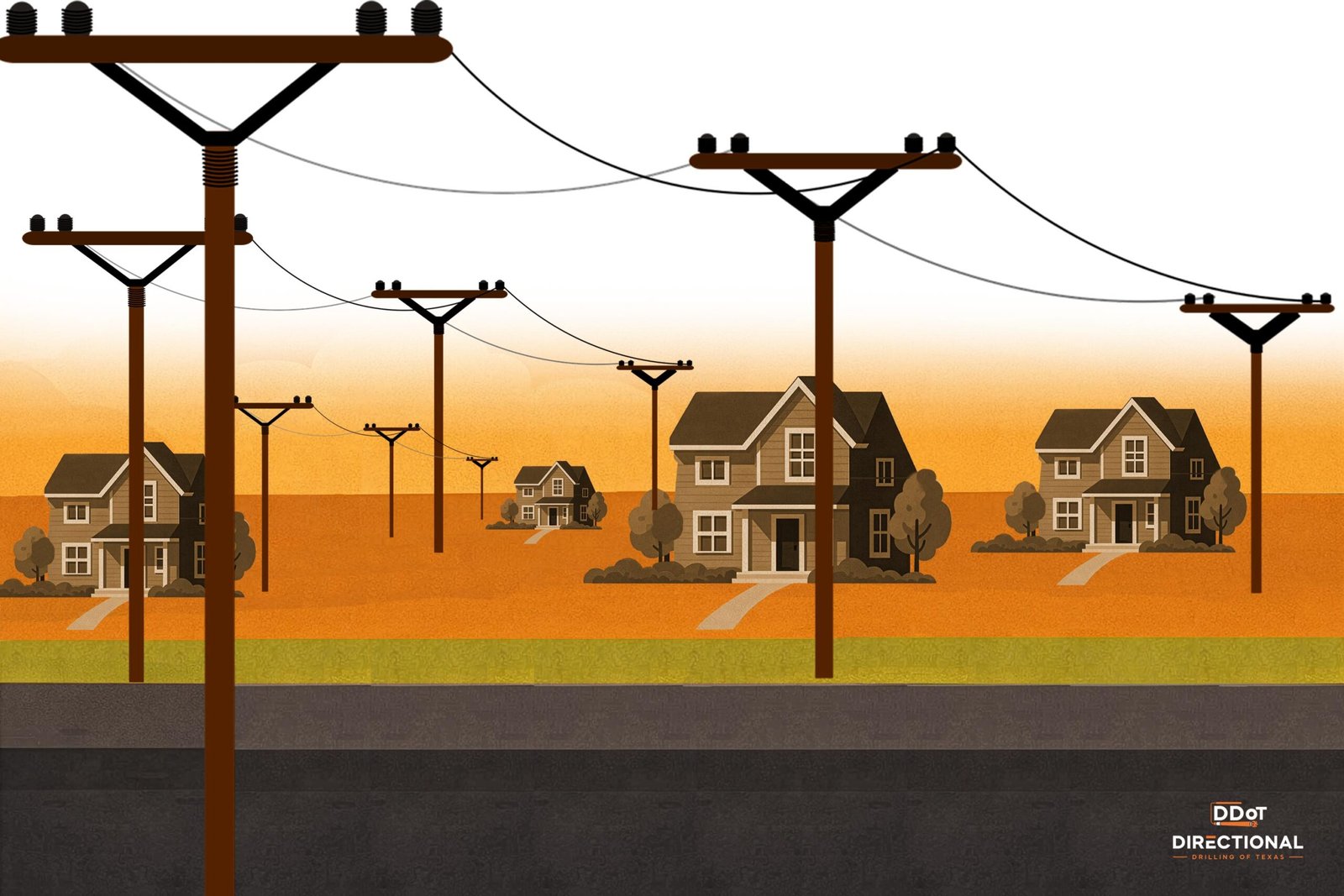
At Directional Drilling of Texas (DDoT), we’re known for our precision underground drilling and conduit installation services that power today’s high-speed fiber networks. While underground boring remains one of the most reliable and secure methods for fiber optic installation, it’s not always the most practical or cost-effective option in every environment. In many cases—especially in rural or hard-to-dig areas—aerial fiber optic cable installation provides a faster and more efficient solution.
What Is Aerial Fiber Installation?
Aerial fiber optic installation involves mounting fiber cables on existing utility poles, often alongside electrical, telephone, or cable TV lines. This approach significantly reduces the need for excavation or trenching, minimizes disruption to the surrounding environment, and accelerates project completion timelines. The result is a quicker, more affordable way to expand or upgrade fiber networks—particularly across long distances or challenging terrain.
Types of Aerial Fiber Optic Cable
Aerial fiber cables are generally classified into two main categories:
● Catenary (Lashed) Systems – These cables are helically lashed to a messenger wire or an existing optical cable, a method commonly used in CATV and broadband applications.
● Self-Supporting Systems – These cables do not rely on a separate messenger wire. Instead, they are designed to support their own weight and tension. Popular self-supporting types include Figure-8 optical cables and ADSS (All-Dielectric Self-Supporting) cables, both known for their strength, cost efficiency, and straightforward installation process.
Self-supporting cables are often used in long-distance communication lines and building-to-building connections, offering an ideal balance between performance and affordability.
Design and Durability Considerations
Because aerial cables are exposed to the elements, their design must account for protection against environmental and physical damage. Aerial fiber installations are engineered to resist common hazards like UV exposure, wind, vibration, and accidental impact. However, they remain more vulnerable than underground systems to extreme weather events such as high winds, ice storms, or flooding, which can increase the risk of service disruption.
Why Choose Aerial Installation?
In many projects, aerial fiber installation offers clear advantages:
● Reduced installation time and cost
● Minimal ground disturbance or excavation
● Efficient use of existing pole infrastructure
Ideal for rural or remote network expansion
At DDoT, we evaluate each project carefully to determine the best installation method—whether aerial or underground—to ensure optimal performance, reliability, and long-term network integrity. Our expertise in both approaches allows us to deliver custom solutions that meet the specific needs of every client and environment.